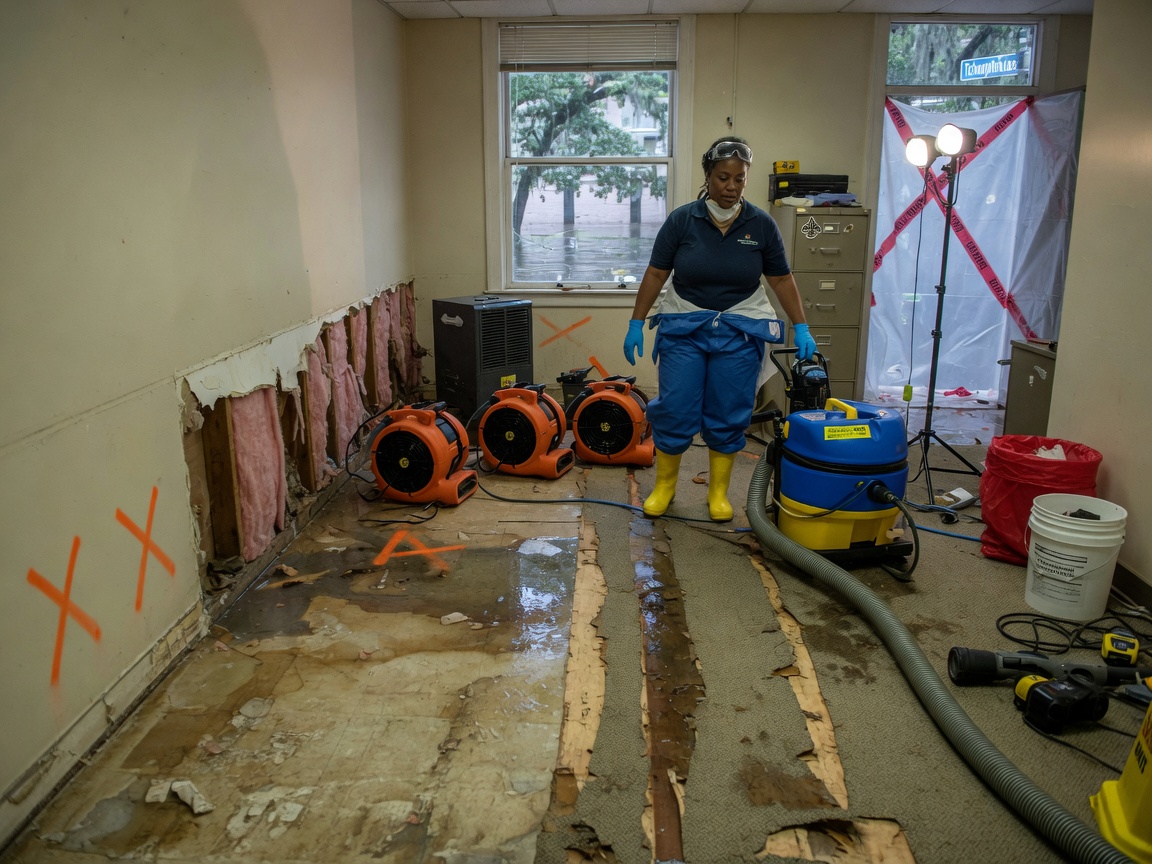
New Orleans healthcare buildings in neighborhoods like Mid-City and Gentilly often feature older plaster and lath construction that absorbs water quickly during subtropical storms. Extraction must account for frequent hurricane-driven flooding that pushes moisture into wall cavities and under slab foundations common in Lakeview and Algiers. Technicians use moisture meters and infrared imaging to locate hidden saturation before mold colonies form in the high-humidity environment of Orleans Parish.
Structural drying in facilities near City Park or the Mercedes-Benz Superdome requires negative-air machines and dehumidifiers sized for the dense historic stock found in the French Quarter and Treme. Standard carpet dryers fail against the thick masonry and raised-floor systems typical of Uptown clinics, allowing residual moisture to migrate into HVAC returns. Crews monitor daily readings for three to five days to meet healthcare sanitation thresholds before any surface restoration begins.
Edge cases arise after storm surges that affect sites in Bywater and Marigny where French drain systems are often absent or clogged. Water can travel laterally under tile floors into adjacent exam rooms, demanding sequential zone drying rather than whole-building approaches. Failure to isolate these paths leaves spores viable in the warm, moist air that persists even after visible water is gone.
Technician insight
In New Orleans the thing that catches most people out with Healthcare Water Extraction and Structural Drying is how quickly moisture travels through the raised wooden floors and plaster in older buildings like those in the Marigny after even modest leaks; the constant subtropical humidity means you cannot rely on open windows or fans the way you might elsewhere, or hidden mold will appear weeks later in HVAC returns.
Mid-City Clinic After Roof Leak
A clinic near City Park experienced ceiling leaks during a summer storm that saturated exam-room walls. Infrared scans revealed moisture had wicked into adjacent corridors through shared plaster. Extraction and targeted drying ran for four days until readings stabilized, allowing the facility to reopen without mold issues.
Healthcare Water Extraction and Structural Drying Services We Offer
✓Hospital Emergency Water Extraction
Rapid removal of standing water from patient care areas using containment barriers to protect sterile zones and limit cross-contamination.
✓Clinic Structural Drying
Targeted drying of exam rooms and waiting areas with equipment that maintains negative pressure and prevents mold in older New Orleans plaster walls.
✓Medical Office Subfloor Moisture Removal
Extraction beneath raised floors common in Uptown and Garden District healthcare buildings to stop hidden saturation from reaching HVAC systems.
✓Healthcare Facility Post-Storm Drying
Full drying protocols after hurricane flooding that account for Orleans Parish humidity levels and the risk of secondary mold in Algiers and Gentilly properties.
✓Laboratory Water Damage Restoration
Controlled drying of lab spaces to protect sensitive equipment while addressing moisture trapped in masonry typical of Mid-City medical buildings.
Healthcare Water Extraction and Structural Drying Cost in New Orleans, LA
| Service | Typical Range | What Affects It |
|---|---|---|
| Initial Assessment and Mapping | $250–$600 | Higher for multi-story or historic structures in French Quarter or Garden District |
| Emergency Extraction per Zone | $400–$900 | Depends on water volume and containment requirements |
| Structural Drying per Day | $350–$750 | Varies with equipment count needed for humidity control |
| Post-Storm Full Facility Dry | $2,200–$5,500 | Influenced by flood depth and number of affected rooms |
Ranges are typical for New Orleans, LA and confirmed with an exact written quote before any work starts.
How it works
- 1
Site Assessment
Technicians inspect all affected zones in the healthcare facility, documenting moisture levels in walls, floors, and HVAC pathways specific to New Orleans construction.
- 2
Containment Setup
Barriers and negative air are established to isolate work areas from patient spaces before extraction begins.
- 3
Water Extraction
Standing water is removed with commercial pumps and wands, focusing on under-slab and cavity areas common after local flooding.
- 4
Structural Drying and Monitoring
Dehumidifiers and air movers run while daily moisture readings track progress until levels match pre-loss conditions.
- 5
Final Clearance
Independent verification confirms no residual moisture remains that could support mold growth in the humid Orleans Parish climate.
Pricing
Costs reflect facility size, access challenges in older buildings, and the need for extended drying time due to local humidity.