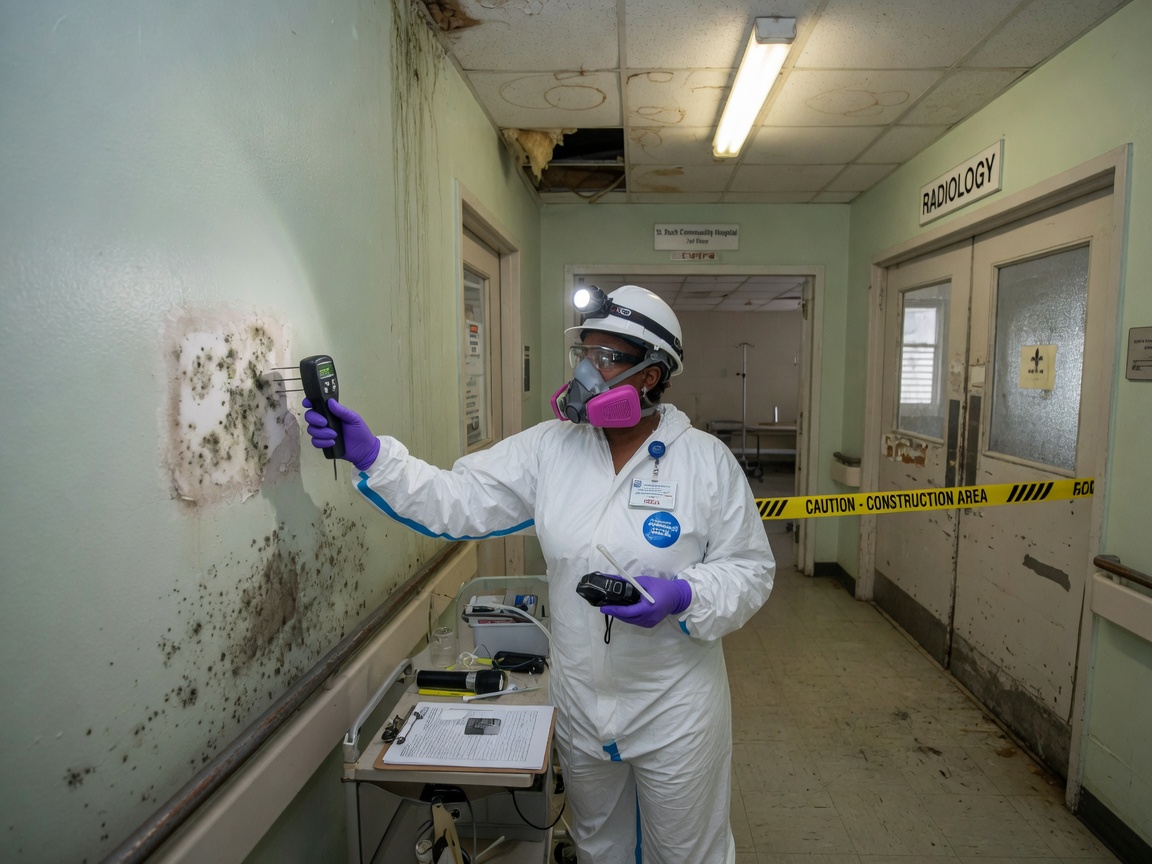
New Orleans hospitals face constant moisture intrusion from the humid subtropical climate and repeated hurricane events that push water into older brick and plaster structures common in Mid-City and Uptown facilities. Inspection teams focus on HVAC systems, interstitial wall spaces, and below-grade mechanical rooms where condensation and roof leaks create hidden growth that standard air sampling often misses. Orleans Parish code requires documented moisture mapping before any remediation begins, especially in patient-care zones where negative-pressure containment must be verified.
Garden District and French Quarter medical buildings frequently retain original limestone foundations that wick groundwater after heavy rains, allowing mold to travel along mortar joints into adjacent corridors. Inspectors use infrared imaging and moisture meters calibrated for local soil conditions rather than relying solely on visual checks. Proximity to Lake Pontchartrain increases salt-air corrosion on metal ductwork, accelerating hidden growth behind ceiling tiles in surgical suites.
Facilities in Algiers and Gentilly often sit on reclaimed land with higher water tables, so inspectors prioritize slab-edge and foundation perimeter checks after each named storm. Documentation includes chain-of-custody forms for samples sent to labs familiar with Louisiana fungal profiles, ensuring results meet state health department expectations for occupied healthcare spaces.
Technician insight
In New Orleans the thing that catches most people out with Hospital Mold Inspection is how quickly salt-laden air from the lake corrodes duct seams in buildings near Gentilly and Lakeview, letting moisture bypass standard filters after even moderate storms.
Mid-City Hospital Post-Storm Check
A hospital near the Superdome reported musty odors in a ground-floor corridor after recent heavy rains. Inspection revealed elevated moisture along the foundation wall where water had entered through an aging expansion joint. Containment recommendations were issued and samples confirmed the growth type before any patient areas were affected.
Hospital Mold Inspection Services We Offer
✓ICU Negative Pressure Verification
Checks airflow and containment integrity in intensive care units to prevent cross-contamination during moisture events common after Gulf storms.
✓ER Waiting Area Sampling
Air and surface sampling focused on high-traffic emergency rooms where rapid patient turnover increases risk of undetected mold spread.
✓Surgical Suite Moisture Mapping
Detailed thermal and moisture scans of operating rooms to locate condensation points behind sterile walls without disrupting procedures.
✓HVAC Duct Inspection
Internal ductwork assessment in older hospital wings across Uptown and Mid-City where corrosion from humid air accelerates hidden growth.
✓Pharmacy Cleanroom Assessment
Targeted inspection of controlled environments storing medications, ensuring compliance with humidity thresholds after seasonal rains.
Hospital Mold Inspection Cost in New Orleans, LA
| Service | Typical Range | What Affects It |
|---|---|---|
| Single Department Inspection | $650–$950 | One ICU or ER wing; increases with after-hours access |
| Full HVAC System Scan | $1,200–$1,800 | Multiple floors in older Uptown or Mid-City buildings |
| Post-Hurricane Assessment | $900–$1,400 | Includes extra moisture mapping after named storms |
| Additional Sample Analysis | $85–$150 | Per extra culture or spore trap beyond base package |
Ranges are typical for New Orleans, LA and confirmed with an exact written quote before any work starts.
How it works
- 1
Initial Facility Walkthrough
Review building plans and recent storm history for the specific New Orleans hospital, noting any flood-prone zones near City Park or Lakeview.
- 2
Targeted Moisture and Air Testing
Deploy meters and pumps in identified high-risk areas such as mechanical rooms and below-grade corridors common in Orleans Parish medical buildings.
- 3
Sample Collection and Lab Submission
Collect surface and air samples with chain-of-custody tracking for analysis of local fungal species.
- 4
Report and Containment Recommendations
Deliver findings with diagrams and next-step guidance for maintaining negative pressure during any follow-up work.
Pricing
Pricing varies by hospital size, number of zones tested, and whether post-storm access is required.